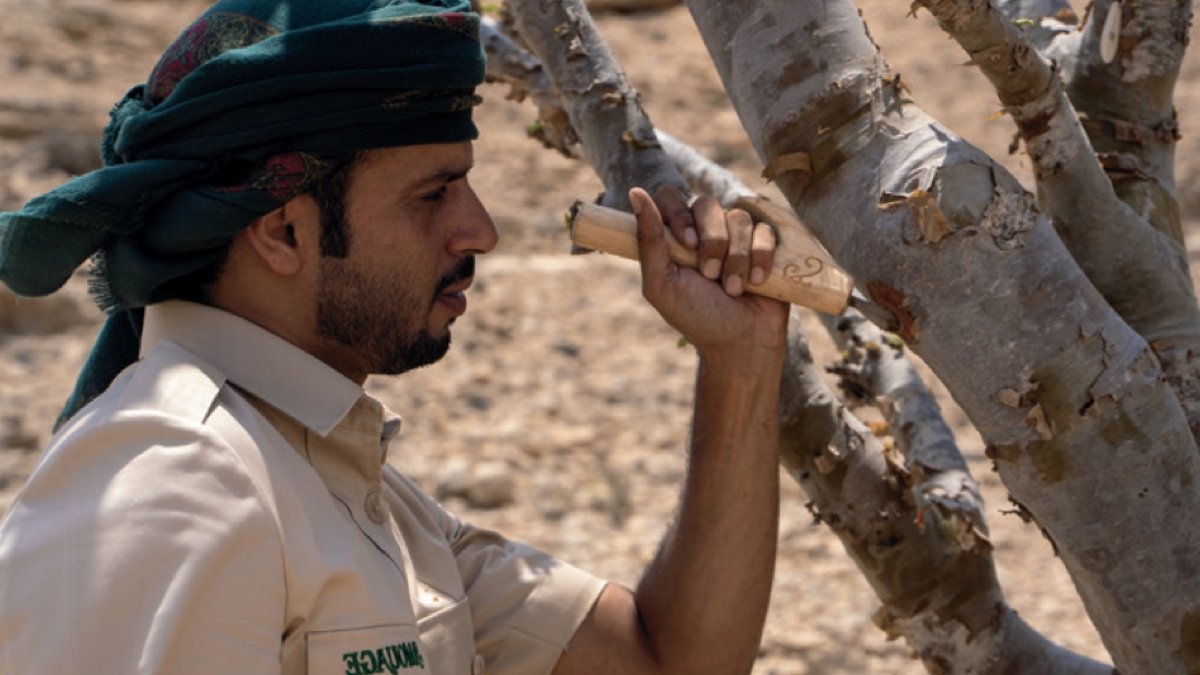
The Dawkah Valley in Oman’s Dhofar region holds the world’s largest reserve of Boswellia sacra, the tree that produces frankincense, according to local authorities. Nearly 5,000 trees grow there, with around 1,000 yielding the prized resin. For Abdallah Jaddad, a 70-year-old farmer leaning against one of the gnarled trunks, the value is clear: “For us, frankincense is more precious than gold. It’s a treasure.” The resin’s prestige extends beyond cultural symbolism—it underpins Oman’s luxury perfume industry, with brands like Amouage selling bottles for hundreds of dollars at high-end retailers such as the Galeries Lafayette in Paris, relying on the expertise of families like the Ben Askar, whose frankincense trade dates back to the 1950s.
This arid valley, inscribed as a UNESCO World Heritage Site in 2000, is one of the few places where the Boswellia thrives. The resin it produces—harvested for millennia, has shaped global trade since the third millennium BCE, traveling by sea and caravan from Dhofar to Mesopotamia, the Indus Valley, Egypt, and as far as Greece, Rome, and China. “Frankincense had about the same value as oil today,” says Ahmed al-Murshidi, director of the Khor Rori archaeological site, whose ancient port once shipped the resin across continents. Beyond its economic worth, the trade routes facilitated cultural exchange, with frankincense used in religious rituals, embalming, and as a status symbol in civilizations from the Nile to the Silk Road.
Read Also: Aquatonale marine biotech lab becomes Belle en Mer
At its heart, the trade relied on the najdi variety, prized for its medicinal and cosmetic properties. “The purest, clearest resin is best for treatment,” explains Faisal Hussein ben Askar, whose family has sold frankincense since the 1950s. His father established a specialized shop in the region decades ago. The region’s green-tinted resin—the rarest and most sought-after, is also used in perfumes and skincare. Several factories in Dhofar already process it into oils and creams, but the highest-grade resin remains a luxury ingredient, often reserved for ceremonial or therapeutic use. The najdi variety’s reputation stems from its higher concentration of active compounds, making it particularly effective in traditional medicine and high-end fragrances.
Ancient Harvest Methods Preserve the Trees
The harvest follows ancient methods: workers make precise cuts in the bark to extract the gum-like sap, which hardens into tears over days. “We cut only five times per tree, always in the same spots,” says Musallam ben Saïd Jaddad, a cultivator. “Never gut the tree, it’ll die.” The process demands skill; overharvesting risks killing the Boswellia sacra, a slow-growing species that can live for centuries. Each incision must be shallow and strategic, allowing the tree to heal while still producing resin.
In 2022, Amouage, Oman’s high-end perfume house, partnered with local authorities to expand the Dawkah reserve. The company now limits harvests per season and assigns unique codes to each tree, tracked by specialists. The goal is sustainability, though development pressures loom. “The government is building roads that could threaten other frankincense groves,” notes Mohammed Faraj Istanbuli, the reserve’s supervisor. “We’re relocating trees to safety. We’ve already saved about 600.” The relocation efforts involve transplanting trees to protected areas within the reserve.
Read Also: Mane strengthens citrus foothold with Cvista acquisition
Oman Builds Local Supply Chain Control
A new distillery is planned to produce frankincense oil locally, reducing reliance on French processing. The move aligns with Oman’s push to control its supply chain, from harvest to final product.
The valley’s frankincense isn’t just a commodity, it’s a living link to antiquity. For generations, its scent has been burned in temples, mixed into unguents, and traded as currency. Today, it remains both a cultural heritage and a luxury ingredient, its value measured in history as much as in dollars. The question now is whether the trees can outlast the trade that once made them priceless.


