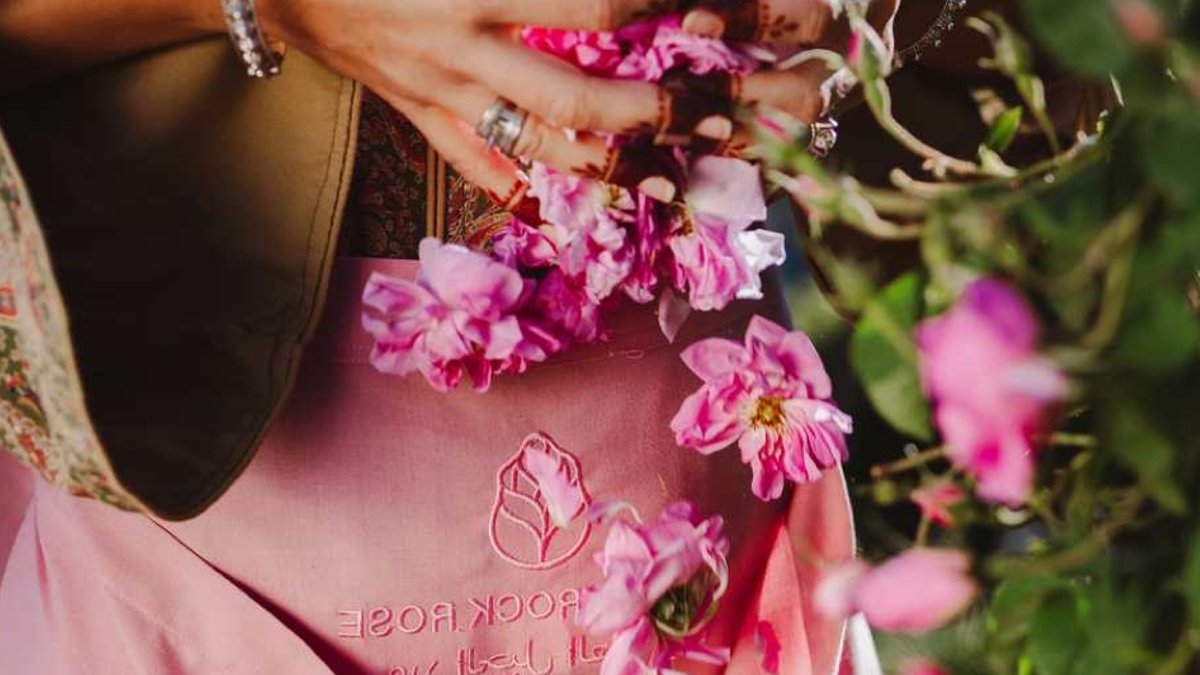
Amouage is laying the groundwork for a new fragrance ingredient derived from the Rose d’Oman. The perfumer is teaming up with LMR Naturals to process the flower, which grows high in the Jabal Akhdar mountains of Oman. This move aims to create a high-quality, natural oil without relying on chemical synthesis, shifting the focus from traditional byproducts to a refined raw material.
The Rose of Jabal Akhdar
The plant, Rosa damascena trigintipetala, thrives in rocky soil at over 2,000 meters. Francesca Bonati, Amouage’s fragrance development director, notes that the cooler climate and mineral-rich soil give this variety a distinct scent profile compared to Turkish or Bulgarian roses. It’s more vivid, greener, and minerally complex. The region’s steep relief and rocky terrain contribute to this unique character.
Related: Dry Skin Demands New Sun Care Strategies
Farmers hand-harvest the flowers between mid-March and late April on the terraces of Jabal Akhdar. They use traditional wood-fired pottery stills, a method that imbues the water of rose with smoky, woody undertones. The essential oil is a byproduct of this process. It is incredibly rare, often produced in volumes no higher than 50 milliliters. In Oman, water of rose is a cultural symbol, though Renaud Salmon, Amouage’s creative director, suggests it has become somewhat of a tourist product.
A Scientific Approach to a Traditional Resource
To scale up, Amouage partnered with LMR Naturals by IFF. Sabrya Meflah, IFF’s fine fragrance president, says this aligns with the vision of LMR founder Monique Rémy. The goal is to create a new ingredient from the traditional water of rose and the essential oil. Bertrand de Préville, LMR’s general director, explains the scientific approach. They will extract aromatic molecules from the distillation water using natural means, not petrochemistry. These molecules will be mixed with the essential oil to create a complete, high-value ingredient that isn’t just a waste product.
This approach mirrors Amouage’s earlier work with Wadi Dawkah incense. Just as the incense project sought to capture a specific, fusing olfactory profile rooted in the region, this rose initiative relies on the unique terroir of Oman. It shifts the focus from generic floral notes to a specific mineral character, distinguishing the brand from competitors who might use synthetic imitations to mimic the scent of roses. Both projects highlight how specific geographical markers can dictate scent chemistry in a way that mass-produced ingredients cannot replicate.
Related: The Brutal Honesty About Massage Guns: Why Your Body Deserves Better Than Quick Fixes
Extraction will occur directly in Oman to avoid damaging the delicate flowers with heat and sunlight. Equipment will be ready for the next harvest cycle in mid-March 2027. The initial volumes will go to Amouage’s creations. Salmon emphasizes this isn’t about using a tiny pinch of rose for novelty. The aim is to have enough quantity to make the ingredient’s unique qualities shine in the final composition, similar to their plans for other raw materials if they can secure the necessary scale.
Beyond the scent, the project supports local farmers. Meflah highlights the transparency, quality, and economic benefits for the community. It could eventually position the region as a global reference for rose cultivation, though current production limits mean this is a long-term goal. The collaboration ensures the process respects the heritage of the area while aiming for a sustainable economic model.

